


After their long-awaited super fight, Floyd Mayweather Jr. and Manny Pacquiao are set to meet again. The rematch is scheduled for Sept. 19 at the Sphere in Las Vegas and will stream globally on Netflix. This distribution model reflects how dramatically the combat sports business has evolved since their first encounter in May 2015.

Their initial bout was billed as the “Fight of the Century” and delivered record-breaking financial results. It generated a $72.2 million gate, more than $410 million in total revenue, and 4.6 million pay-per-view buys, figures that remain historic benchmarks for boxing. Inside the ring, however, the contest was far less dramatic. Mayweather controlled the tempo from the opening bell, using his trademark defensive precision, footwork, and jab to secure a clear unanimous decision (118-110, 116-112, 116-112).
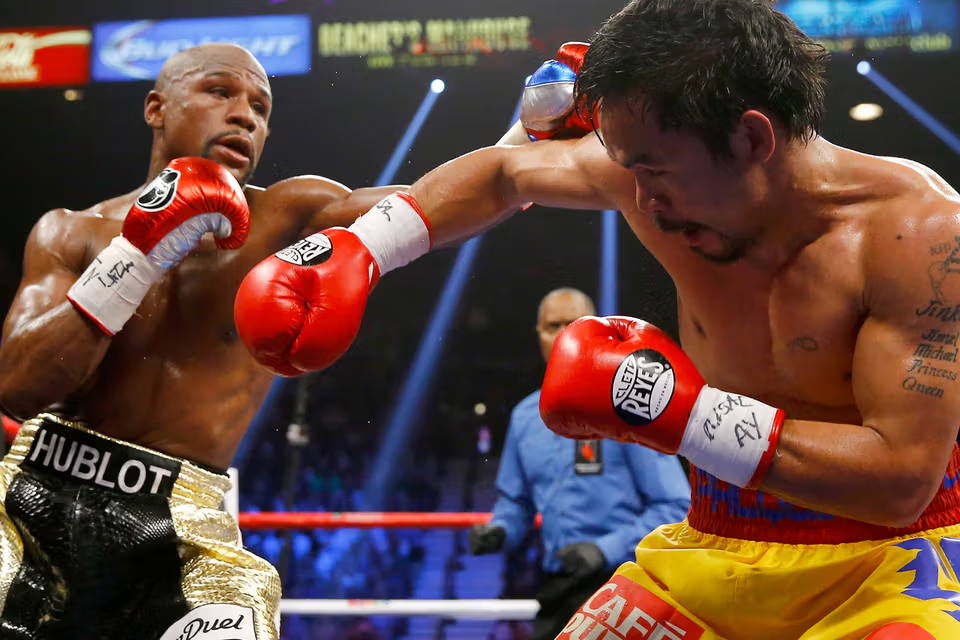
In the aftermath, Pacquiao revealed he had suffered a shoulder injury during training camp that limited his performance. He campaigned for a rematch, but Mayweather — having preserved his undefeated record — showed little interest in revisiting the matchup.
The landscape today is very different.

Mayweather, now 49, has not fought professionally since stopping former UFC champion Conor McGregor in 2017. In the years since, he has participated primarily in exhibition bouts and crossover spectacles. Pacquiao, 47, has been comparatively active. Following his loss to Mayweather, he compiled a 5-2-1 record across eight fights, notching victories over notable names while also suffering defeats to Jeff Horn and Yordenis Ugas. After announcing his retirement in 2021, Pacquiao returned in 2024 to challenge Mario Barrios, fighting to a majority draw.

The catalyst for this rematch is as much economic as competitive. Netflix’s entry into live combat sports has altered the revenue model. The 2024 clash between Jake Paul and Mike Tyson reportedly drew 108 million global viewers on the platform, demonstrating that marquee names, even past their athletic primes, can generate massive audiences without relying on traditional pay-per-view sales. For Mayweather and Pacquiao, whose brands still carry global recognition, the streaming model offers substantial guaranteed revenue and worldwide reach.
From a competitive standpoint, both fighters are well removed from their physical peaks. Mayweather’s last bout against a prime, elite boxer came in 2015 against Andre Berto. While he has maintained excellent conditioning, reflex-driven defensive styles often decline subtly with age. Pacquiao, once defined by relentless volume and explosive angles, is no longer the whirlwind force that dominated the welterweight division in the late 2000s. Still, he has remained closer to championship-level competition in recent years.

The venue itself adds another dimension. The Sphere, a technologically advanced $2.3 billion entertainment arena, previously hosted UFC 306 in 2024 and is designed to deliver immersive audio-visual spectacle. The event’s production value could rival — or surpass — traditional mega-fights.
Ultimately, expectations must be tempered. If Mayweather can replicate the disciplined, risk-averse strategy that neutralized Pacquiao in 2015, the rematch could follow a similar script. If Pacquiao’s shoulder injury materially affected the first fight, and if he can increase his offensive output this time, the sequel may prove more competitive.
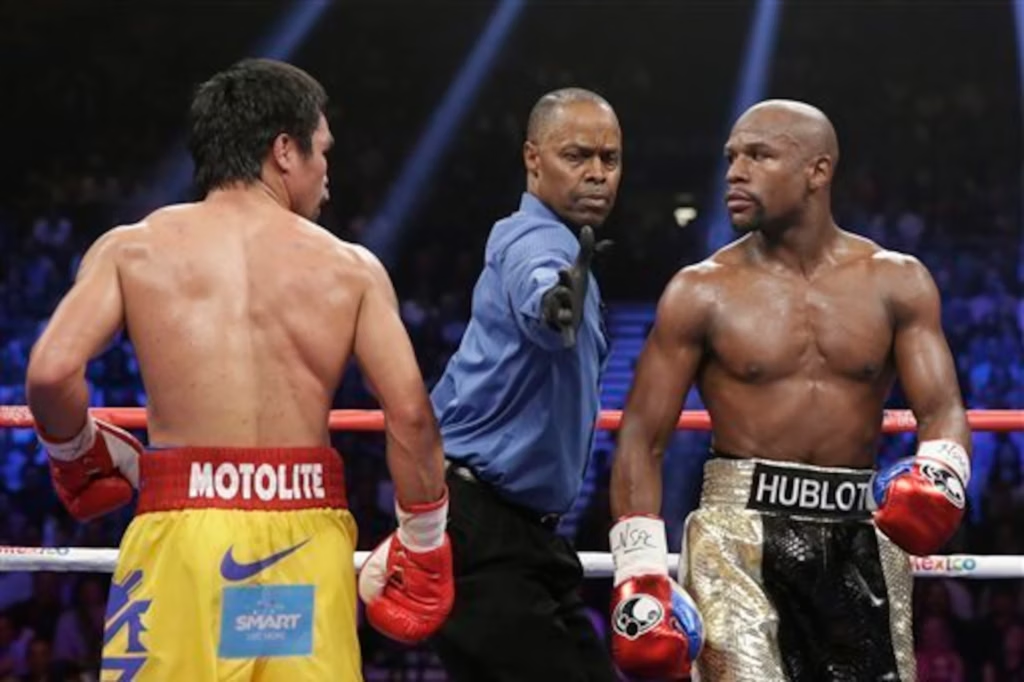
What is certain is this: while the stakes are no longer about prime supremacy, they remain significant, legacy, pride, and the opportunity to redefine a rivalry that once captivated the boxing world.